
Why Does ChatGPT Make Stuff Up? (AI Hallucination Explained Simply)
ChatGPT makes things up because it predicts text, it doesn't look up facts. This is called hallucination, and every AI tool does it, not just ChatGPT. Verify specific facts, citations, and statistics before you use them, and never rely on AI alone for medical, legal, or financial decisions.
Akhilesh Angadi
Founder of NeuralSutras · writes about practical AI & software · 20 July 2026
TL;DR: ChatGPT makes things up because it predicts text, it doesn't look up facts. This is called hallucination, and every AI tool does it, not just ChatGPT. Verify specific facts, citations, and statistics before you use them, and never rely on AI alone for medical, legal, or financial decisions.
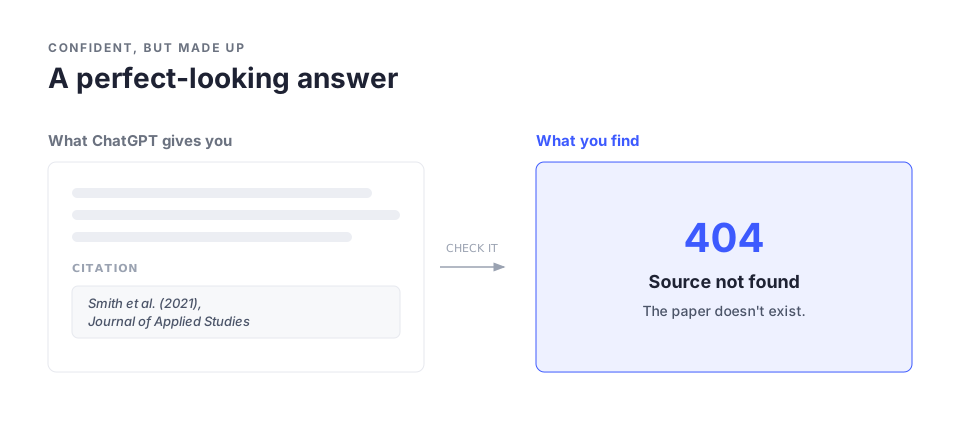
You asked ChatGPT a question. It gave you a confident, well-written answer, complete with a citation, a statistic, or a specific fact.
Then you looked it up, and it didn't exist. The paper was fake. The number was invented. The date was wrong. But ChatGPT sounded completely sure of itself.
If that's happened to you, you've met AI hallucination. Use these tools long enough and everyone does.
This isn't a bug that gets patched in the next update. It's part of how the systems work, and once you understand why, you become a much sharper AI user and you stop making the embarrassing (or expensive) mistakes.
What is AI hallucination?
It's when a model like ChatGPT, Claude, or Gemini produces information that's plain wrong but presents it as true. (IBM)
The word is borrowed from psychology, where a hallucination is seeing something that isn't there. In AI it means generating something that isn't real: a fake source, a wrong number, an event that never happened, a person who doesn't exist.
The unsettling part isn't that AI gets things wrong. People do too. It's that AI gets them wrong with total confidence and no sense that it might be off. (OpenAI)
Why it happens, in plain terms
Everything clicks once you understand one thing about ChatGPT.
It isn't a search engine. It doesn't look things up in a database or check Wikipedia before answering. What it does is predict the most likely next word, again and again, until it has a sentence, then a paragraph, then a full answer. (OpenAI)
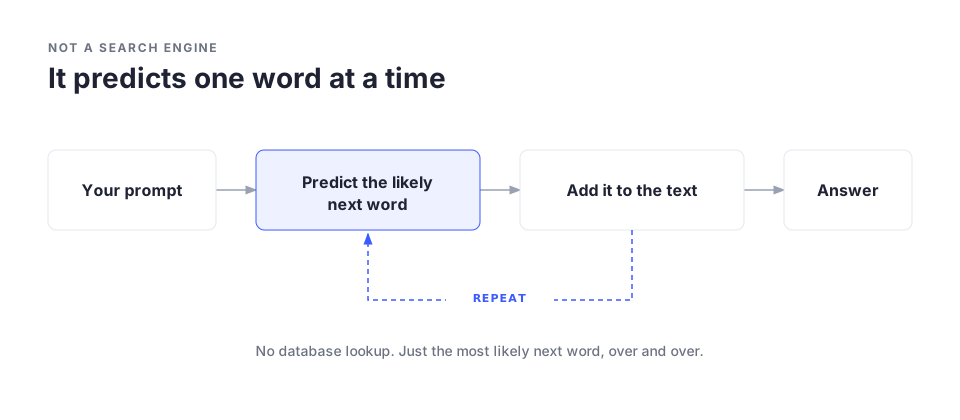
It learned to do this by reading an enormous amount of text: books, websites, articles, forums, documentation. From all of it, it picked up patterns. Which words tend to follow which. Which sentence shapes make sense. Which kinds of answers fit which kinds of questions.
So when you ask a question, it isn't pulling an answer out of storage. It's building one, word by word, from what statistically tends to come next. Most of the time that works, because the patterns it learned are good ones.
But when there's no solid pattern to lean on, it fills the gap anyway. It produces something that sounds plausible and has the shape of a correct answer, even when the content is wrong. That's hallucination. Not lying, not a malfunction, just a confident guess poured into a gap.
A simple analogy
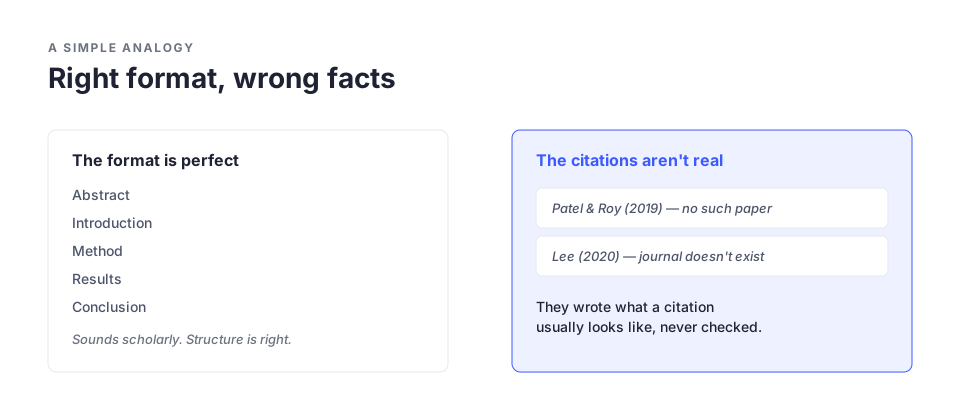
Picture someone who has read thousands of academic papers. They know the format cold: abstract, introduction, method, results, conclusion, references.
Now ask them to write a paper on a topic they don't actually know. They can. It'll look exactly right. The structure will be perfect and the sentences will sound scholarly. But the citations might point to papers that don't exist, because they never checked. They just wrote what a citation in that spot usually looks like.
ChatGPT does the same thing, across every subject at once.
Why it sounds so sure
This is the part that trips people up. If ChatGPT doesn't know something, why doesn't it just say so?
Because the model doesn't know what it doesn't know. Uncertainty is a human feeling. When you're unsure, something inside flags it before you speak. A language model has no such alarm. It generates fluent text from patterns, and those patterns don't carry a reliable "I'm not sure about this one" signal. It was trained to be helpful and coherent, not to hesitate. (OpenAI)
Newer models are getting better at flagging doubt when you ask them to. But the default is confidence, because confident, complete answers are what the training text mostly looked like.
What AI hallucinates most
Some requests are far riskier than others. Hallucination shows up most when you ask for:
- Exact numbers: statistics, percentages, dates, prices, population figures. These are exactly the details that need looking up, and looking up is the one thing the model can't do.
- Citations and references: the classic trap. Ask for sources and you'll often get real-looking author names, journals, and years that match no actual paper.
- Recent events: most models have a knowledge cutoff. Ask about something after it and you may get confident misinformation instead of "I don't know."
- Quotes from real people: it will hand you convincing quotes those people never said.
- Niche or specialist topics: the more specialised the field, the less good training data exists, so medical, legal, financial, and deeply technical questions carry more risk.
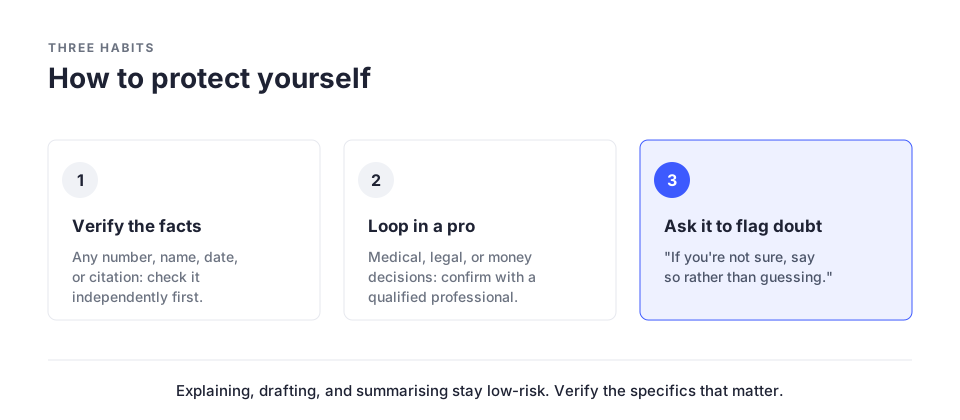
Three habits that protect you
1. Verify any specific fact before you use it
Whenever you get a number, a name, a date, a statistic, or a citation, check it independently first.
You don't need to fact-check everything. General explanations, writing help, brainstorming, summaries: all low-risk, and hallucination rarely bites there. The risk spikes when the details matter, like when you're publishing, submitting for a grade, making a business call, or passing information to others. The rule is simple: if the specific fact matters, check it yourself.
2. Don't act on AI for medical, legal, or financial decisions without a professional
These are the three areas where a confident wrong answer does real damage. AI is a fine starting point here, for understanding a concept or drafting questions to ask your doctor. But verify anything it tells you with a qualified professional before you act. The stakes are too high for a guess.
3. Ask it to flag its own uncertainty
This doesn't cure hallucination, but it helps. When you're after facts, add a line like:
"If you're not sure about any specific fact, say so rather than guessing."
That nudges the model to surface doubt instead of papering over it. It won't catch everything, but it makes a difference, especially with newer models.
A quick reference card
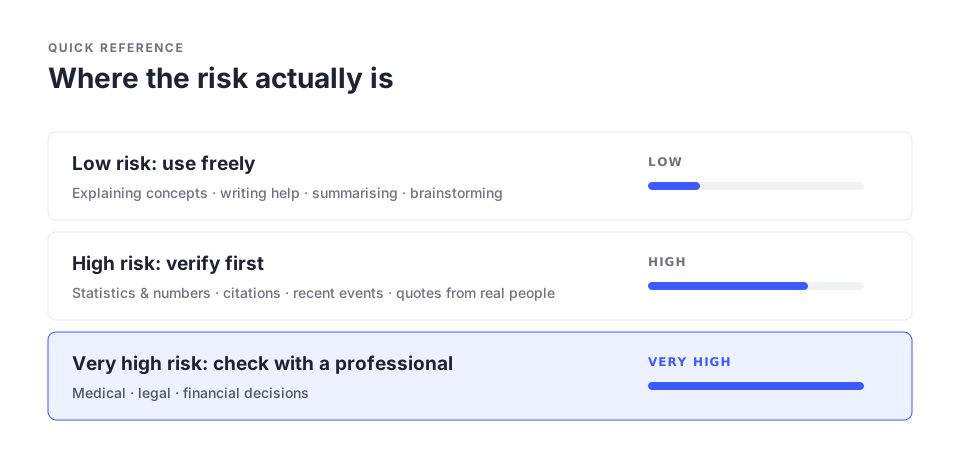
Screenshot this:
| Situation | Risk | What to do |
|---|---|---|
| General explanation of a concept | Low | Use freely |
| Writing help, editing, summarizing | Low | Use freely |
| Brainstorming, creative work | Low | Use freely |
| Specific statistics or numbers | High | Verify independently |
| Citations and source lists | High | Assume fake until confirmed |
| Recent events (last 1-2 years) | High | Cross-check a current source |
| Medical, legal, financial advice | Very high | Verify with a professional |
| Quotes attributed to real people | High | Confirm before repeating |
Practical checklist
Before you use anything AI wrote, run through this:
- Any specific statistic, number, or date? Verify it independently.
- Any citations or source references? Search for each one first.
- About a recent event (last 12 to 18 months)? Cross-check a current source.
- Feeding a medical, legal, or financial decision? Confirm with a professional.
- Quotes or attributions to a real person? Check the quote exists before repeating.
- Did you ask it to flag uncertainty? If not, re-prompt.
All clear? Safe to use. Any box ticked? Verify first.
Key takeaways
- AI doesn't lie on purpose. It predicts text; it doesn't retrieve facts.
- Hallucination is the model filling a gap with a plausible guess.
- Every major tool (ChatGPT, Claude, Gemini) does it. It's not unique to one.
- Citations and statistics are the riskiest output. Always verify.
- Never rely on AI alone for medical, legal, or financial decisions.
- Asking it to flag uncertainty reduces hallucination, though it won't remove it.
- For brainstorming, drafting, and explaining, AI is low-risk and genuinely useful.
The bottom line
ChatGPT isn't lying to you. It's doing exactly what it was built to do: generate fluent, helpful-sounding text from patterns it learned.
The catch is that pattern-matching and fact-retrieval are different jobs. Being brilliant at one doesn't make it good at the other.
Once that lands, your whole relationship with these tools shifts. You stop trusting them blindly and start using them well: for the things they're genuinely good at (explaining, drafting, summarising, brainstorming), while you verify the things that matter. That's not a limitation. That's just how you use any tool properly.
Frequently Asked Questions
Can ChatGPT lie on purpose? No. It has no intentions. It generates text by predicting likely word sequences. What looks like a lie is a plausible gap-fill, not deception.
Does Claude hallucinate too? Yes. Every large language model does, including Claude, Gemini, and Llama. Some are better at expressing doubt, but none are immune.
Which one hallucinates the least? It shifts with every model update and depends on the task. None are reliably hallucination-free, so verify specific facts whatever you use.
Can hallucination be prevented entirely? Not today. It's structural, not a simple bug. Techniques like Retrieval-Augmented Generation (RAG), where the model checks a verified database before answering, cut it down a lot but don't remove it.
What's the best way to catch a made-up fact? Search for it yourself. For citations, paste the title into Google Scholar or check the publisher directly. For statistics, find the original source. If the AI can't say where a number came from, treat it as unverified.
Further Reading
- OpenAI: Why language models hallucinate: OpenAI's own explanation of why training can reward guessing over admitting doubt
- IBM: What are AI hallucinations?: an accessible overview of the causes
- MIT Sloan: Addressing AI hallucinations and bias: MIT's practical guide to reducing them
- NIH/PMC: Is artificial intelligence hallucinating?: a peer-reviewed analysis of intrinsic versus extrinsic hallucination
- Ji et al. (2023), "Survey of Hallucination in Natural Language Generation": an academic overview (ACM Computing Surveys)
What's Next
Now you know why AI makes things up, you might be wondering:
- What should you actually share with ChatGPT? Is ChatGPT Safe to Use?
- Which AI tool fits your job? Best AI Tool for Your Job, by Role
Enjoyed this guide? Subscribe to the NeuralSutras newsletter for one practical AI lesson every Sunday, and follow our YouTube channel for step-by-step tutorials.
NeuralSutras. Practical AI for Everyone. Have a question or correction? We want to know: hello@neuralsutras.com
Akhilesh Angadi
Founder of NeuralSutras · writes about practical AI & software. Every NeuralSutras guide is tested, honest about limitations, and written to stay useful long-term.
One practical AI lesson, every week
No hype. No news roundups. Just one actionable guide on using AI to work smarter, every Sunday.
Subscribe free →