
Will AI Take Your Job? Here Is the Honest Answer
AI isn't going to erase most jobs. It automates specific tasks inside jobs, which changes what the job looks like. The people most exposed do highly repetitive, rule-based work with no physical or human element. The people best positioned spot which of their tasks AI is changing and adapt.
Akhilesh Angadi
Founder of NeuralSutras · writes about practical AI & software · 10 August 2026
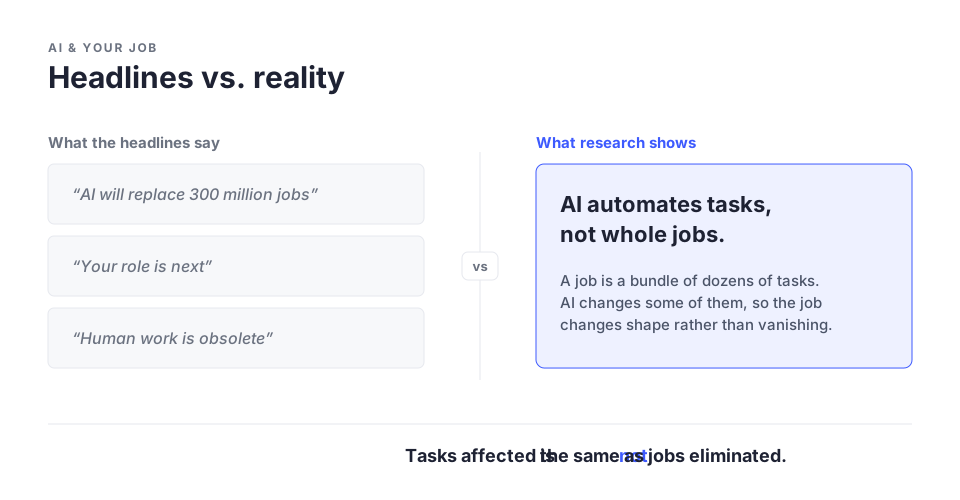
TL;DR: AI isn't going to erase most jobs. It automates specific tasks inside jobs, which changes what the job looks like. The people most exposed do highly repetitive, rule-based work with no physical or human element. The people best positioned spot which of their tasks AI is changing and adapt.
You've seen the headlines. "AI will replace 300 million jobs." "Your role is next." They run every week, and it's hard not to feel a low hum of worry when they do.
Most of them are wrong. Or more honestly, they mix up two things that aren't the same, and that mix-up is doing most of the panicking for you.
The headline problem
When a headline says "AI will replace jobs," it's usually built on research that said something narrower: AI can automate certain tasks that happen to sit inside jobs.
Those aren't the same claim. Your job isn't one thing. It's a bundle of dozens of tasks. If AI takes over a fifth of them, the job doesn't vanish. It changes shape. You either use AI to clear those tasks faster, or they stop being the centre of your role.
Take the Goldman Sachs number everyone quotes: 300 million jobs "exposed" to automation. Read the actual report and "exposed" means those jobs contain tasks AI could help with. It does not mean 300 million jobs disappear. (McKinsey Global Institute)
We've been here before, too. Industrialisation, electricity, the PC, the internet: each one arrived with confident predictions of mass unemployment, and each prediction got net employment wrong. Real people were disrupted. Specific tasks vanished. New work showed up to replace them.
Ask a better question
So don't ask "Will AI take my job?" Ask this instead: "Which of my tasks will AI affect, and what should I do about it?"
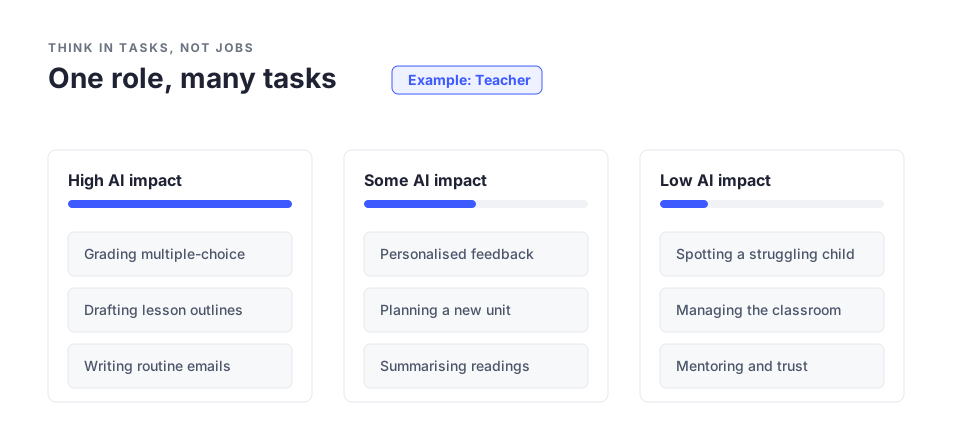
That version is useful because you can actually answer it. You can list your tasks, look at each one, and decide where your time is best spent.
The tasks AI hits hardest tend to share a few traits. They're structured, with a clear input and a clear correct output. They're about spotting patterns in data or text. They repeat. They live entirely on a screen, with no physical step. And they don't need you to read a person or earn their trust.
The tasks AI struggles with are the mirror image: messy situations that need judgment, physical presence, a real relationship, accountability, and the ability to handle something genuinely new.
What AI still can't do
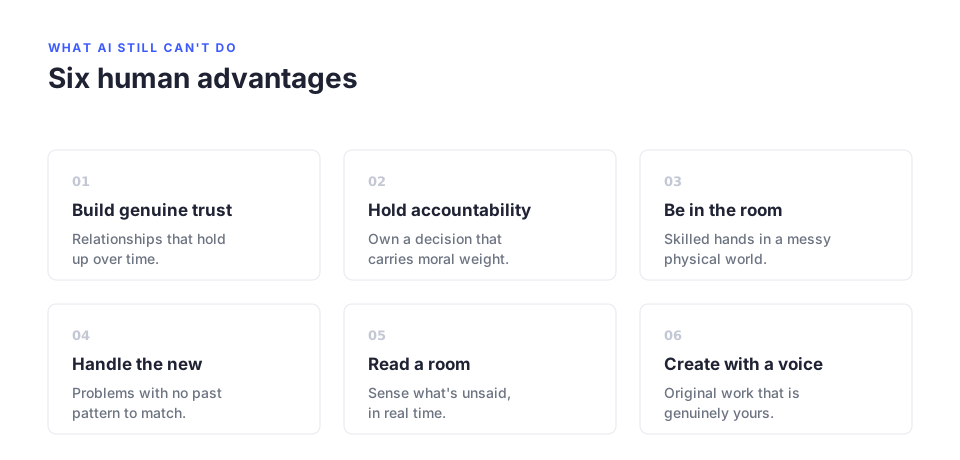
These aren't gaps waiting for the next model update. They're baked into how today's AI works.
It can't build genuine trust. AI can sound warm and write empathetic sentences, but it doesn't actually care about you or carry a real relationship across time. A patient who feels looked after by their nurse is experiencing something no model produces.
It can't hold accountability. When a decision carries moral weight and someone has to answer for it, like a judge passing a sentence or a manager letting someone go, a human has to own it. AI can help you think. It can't be responsible.
It can't be in the room. Plumbers, electricians, nurses, carpenters: skilled hands working in an unpredictable physical space. Robotics is improving, but the real world is still very hard.
It can't handle the genuinely new. AI is great at matching a situation to patterns it has seen. When nothing in its training looks like what's in front of you, it gets shaky. The stranger the problem, the more it needs a person.
It can't read a room in real time. The teacher who notices a student is lost before they say a word. The salesperson who senses that now is the wrong moment. That live social read isn't something AI does yet.
Where AI actually helps at work
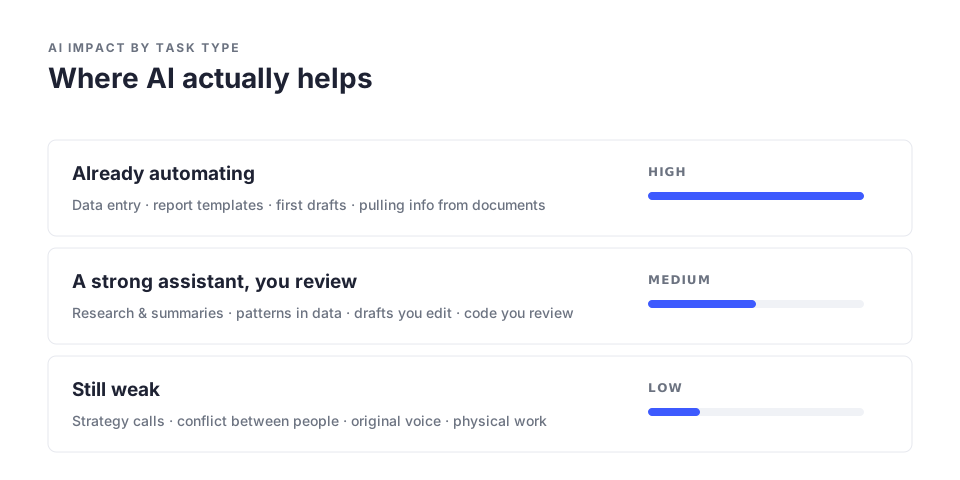
To be concrete about what's changing:
Already automating: data entry and formatting, standard report templates, first drafts of routine content, pulling information out of documents, answering common support questions.
A strong assistant, with you in the loop: research and summaries, finding patterns in data, drafts that still need your edit, code you review before shipping.
Still weak: strategic calls, sorting out conflict between people, original creative work with a real voice, anything physical, anything where accountability matters.
Who's genuinely at risk
The honest answer: people whose jobs are made mostly of the "already automating" tasks. Data entry, basic content writing, some customer service, routine bookkeeping.
That's real disruption, and it isn't fun to live through. But it tends to be a transition rather than a disappearance, closer to how word processors changed what secretaries did than to secretaries ceasing to exist. The roles most exposed are the ones built almost entirely from structured, screen-based, rule-following tasks whose output can be checked objectively.
Who's best positioned
The people who come out ahead do three things. They work out which of their tasks AI can take. They learn to use AI on those, so they get faster. Then they pour the freed-up time into the work AI can't touch, which is where their real value sits.
It's a simple plan. Most people won't follow it, because it means actually looking at your job instead of waiting for the worry to pass.
A 20-minute career audit
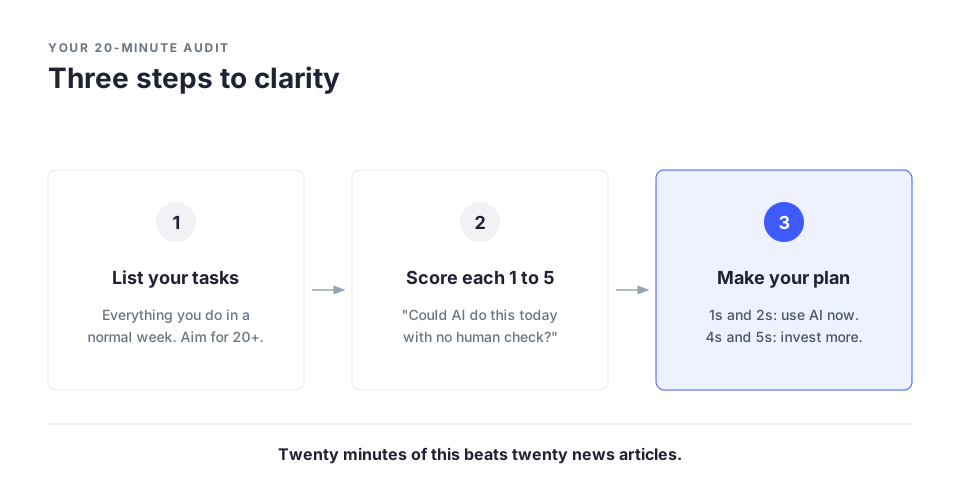
Here's the exercise. It's quick, and it gives you real clarity.
1. List your tasks. Write down everything you do in a normal week. Be specific: not "write reports" but "pull data from three systems into a monthly performance report." Aim for twenty or more. Stuck? Ask an AI to list the common tasks for your role, then adjust.
2. Score each one. For every task ask, "Could AI do this today with no human check?" Score it 1 to 5. A 1 or 2 means AI could largely do it now. A 3 means AI helps a lot but your judgment still matters. A 4 or 5 means it needs a human: relationships, physical work, ethical calls.
3. Make a plan. For the 1s and 2s, start using AI on them this week. If you don't, you'll end up slower and pricier than the colleague who does. For the 4s and 5s, invest more. That's your edge, and strengthening it is what makes your career hard to replace.
A quick checklist
- List 20+ tasks from a normal work week
- Score each 1 to 5 for how automatable it is
- Pick your top 3 that scored 1 or 2, and use AI on them this week
- Pick your top 3 that scored 4 or 5, and plan how to grow them
- Check which tool fits your role: Best AI Tool for Your Job
- Set a three-month goal: be measurably faster on your automatable tasks
Key takeaways
- "AI will automate tasks" is true. "AI will eliminate jobs" is mostly not.
- Every job is a bundle of tasks. AI affects some of them, not all.
- Most affected: structured, repetitive, rule-based tasks with no physical or human element.
- Least affected: judgment, relationships, physical presence, genuine novelty.
- The people who thrive use AI on their automatable tasks, then pour the saved time into the work only they can do.
- The 20-minute audit gives you more clarity than twenty news articles.
- The anxiety comes from not knowing which bucket your tasks fall in. The audit fixes that.
The bottom line
"Will AI take my job?" is the wrong question. It hands you anxiety with nowhere to put it.
"Which of my tasks will AI change, and what does that mean for my week?" is a question you can answer. Do that for your actual role, not in the abstract, and the worry usually shrinks while the next step gets obvious.
The people least ready for AI are the ones treating it as something happening to them. The people most ready have run the audit, found their automatable tasks, started using AI for them, and leaned harder into the work only they can do.
Frequently Asked Questions
Which jobs are most at risk? Roles built mostly from structured, repetitive, on-screen tasks with no physical or interpersonal side: data entry, some customer service, basic content, routine accounting. Usually it's the most automatable tasks within the job, not the whole thing.
Which jobs are most protected? Ones that need physical presence (trades, healthcare), real relationships (therapy, teaching, leadership), complex ethical judgment (law, medicine, management), or clear accountability.
Should I be learning AI tools? Yes, for the automatable tasks in your role. Not because AI will replace you, but because colleagues who use it there will simply get more done. That gap is real.
What if my whole job feels automatable? Worth taking seriously. If your role is almost entirely structured, rule-based work with no physical or human element, it's more exposed than most. Start building adjacent skills in the harder-to-automate areas, like client relationships, complex judgment, or hands-on work, while you still have room to move.
Is AI's pace making this faster? Yes. Tasks that look safe today may be automatable in three to five years. That's the reason to run the audit now instead of later.
Further Reading
- McKinsey: AI, automation, and the future of work: ten dimensions of how AI is reshaping employment
- BCG: AI Will Reshape More Jobs Than It Replaces: 50 to 55% of jobs reshaped versus roughly 10 to 15% at risk of elimination
- MIT Automation, AI & Work: peer-reviewed research on displacement and new task creation
- Best AI Tool for Your Job by Role: which tool fits your profession
- MIT Work of the Future: rigorous research on AI and employment
- How ChatGPT Actually Works: understanding the tool that's changing your industry
What's Next
- Best AI Tool for Your Job by Role: once you've done the audit, this tells you which tool to use for your automatable tasks
- What Are MCP Servers? (coming soon): the next layer of AI arriving in professional workflows
Enjoyed this guide? Subscribe to the NeuralSutras newsletter for one practical AI lesson every Sunday, and follow our YouTube channel for step-by-step tutorials.
NeuralSutras. Practical AI for Everyone. Have a question or correction? We want to know: hello@neuralsutras.com
Akhilesh Angadi
Founder of NeuralSutras · writes about practical AI & software. Every NeuralSutras guide is tested, honest about limitations, and written to stay useful long-term.
One practical AI lesson, every week
No hype. No news roundups. Just one actionable guide on using AI to work smarter, every Sunday.
Subscribe free →